Back to Research & Perspectives
Building Nike: Notes from Shoe Dog
Phil Knight’s memoir offers a detailed account of how Blue Ribbon Sports developed into Nike through product conviction, complementary team members, financing, and cross-border partnerships.
Shoe Dog is Phil Knight’s account of Nike’s development from 1962 onward. The book is especially useful because it presents the company before its strategy, organization, and brand had taken a settled form.
Nike is now widely recognized as an established global sportswear company. The memoir draws attention instead to the early operating decisions and relationships behind that outcome. Nike was shaped not only by its founders, but also by employees, athletes, suppliers, banks, and other business partners.
The story begins before the company existed. After Stanford Business School, Knight travelled around the world and pursued what he called his “Crazy Idea”: importing Japanese running shoes into the United States. He approached Onitsuka in Japan and secured the right to distribute Tiger shoes through Blue Ribbon Sports.
This was not a fully formed plan for Nike. It was an initial distribution business built around Knight’s view that Japanese running shoes could compete in the American market. The company, product line, and brand developed gradually from that starting point.
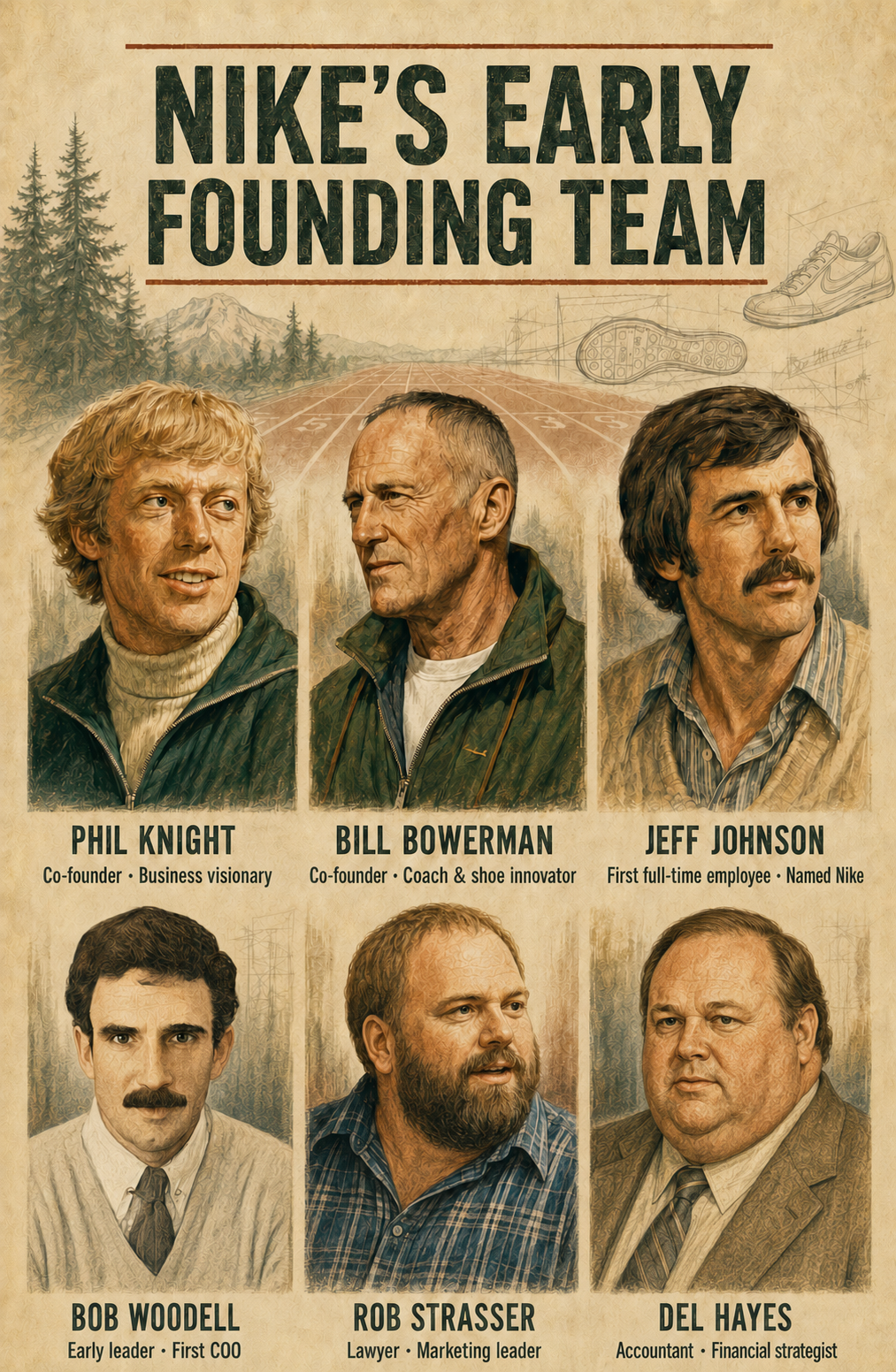
One of the clearest themes is the importance of a complementary early team. Knight drove the commercial direction, while Bill Bowerman contributed coaching knowledge and product experimentation. Jeff Johnson developed early customer relationships and proposed the Nike name. Bob Woodell, Rob Strasser, and Del Hayes added operational, legal, marketing, and financial capabilities. The company’s development depended on this combination rather than on one founder working alone.
The role of Japanese business partners
Two Japanese companies played particularly important roles: Onitsuka Tiger and Nissho Iwai, now part of Sojitz.
Onitsuka’s Tiger shoes gave Blue Ribbon its first product and helped it establish a position in the US running market. The later breakdown of that relationship also pushed Blue Ribbon to develop its own brand and supply base. Nissho subsequently provided financing when Nike’s rapid growth created severe pressure on cash and its banking relationships.
What the book shows about company building
Shoe Dog also shows that company building is rarely a linear process. Nike’s early years involved product experiments, supplier disputes, financing constraints, legal conflicts, and repeated adjustments to the organization. Its brand emerged alongside these practical decisions; it was not created separately from them.
Companies are often examined through technology, markets, capital, and competitive positioning. Shoe Dog shows how these factors are connected through people and working relationships.
Nike’s history can be read not as the execution of a complete founding vision, but as the cumulative result of product knowledge, complementary capabilities, external partnerships, and adaptation under pressure.